
Voltage Drop Calculator
Calculate voltage drop, remaining voltage, and voltage drop percentage from your circuit and wire parameters.
Related Calculators
How to Use This Calculator
- 1Enter the circuit voltage.
- 2Enter the current flowing through the circuit.
- 3Enter the conductor length.
- 4Select the wire gauge.
- 5Select the conductor material.
- 6Click Calculate to determine the voltage drop.
- 7Review the voltage drop, remaining voltage, and voltage drop percentage.
Common Uses
- Estimating voltage drop for electrical wire runs
- Comparing the effect of different wire sizes
- Evaluating how conductor length affects voltage drop
- Comparing copper and aluminum conductors
- Checking voltage-drop calculations for supported circuit configurations
What Is Voltage Drop?
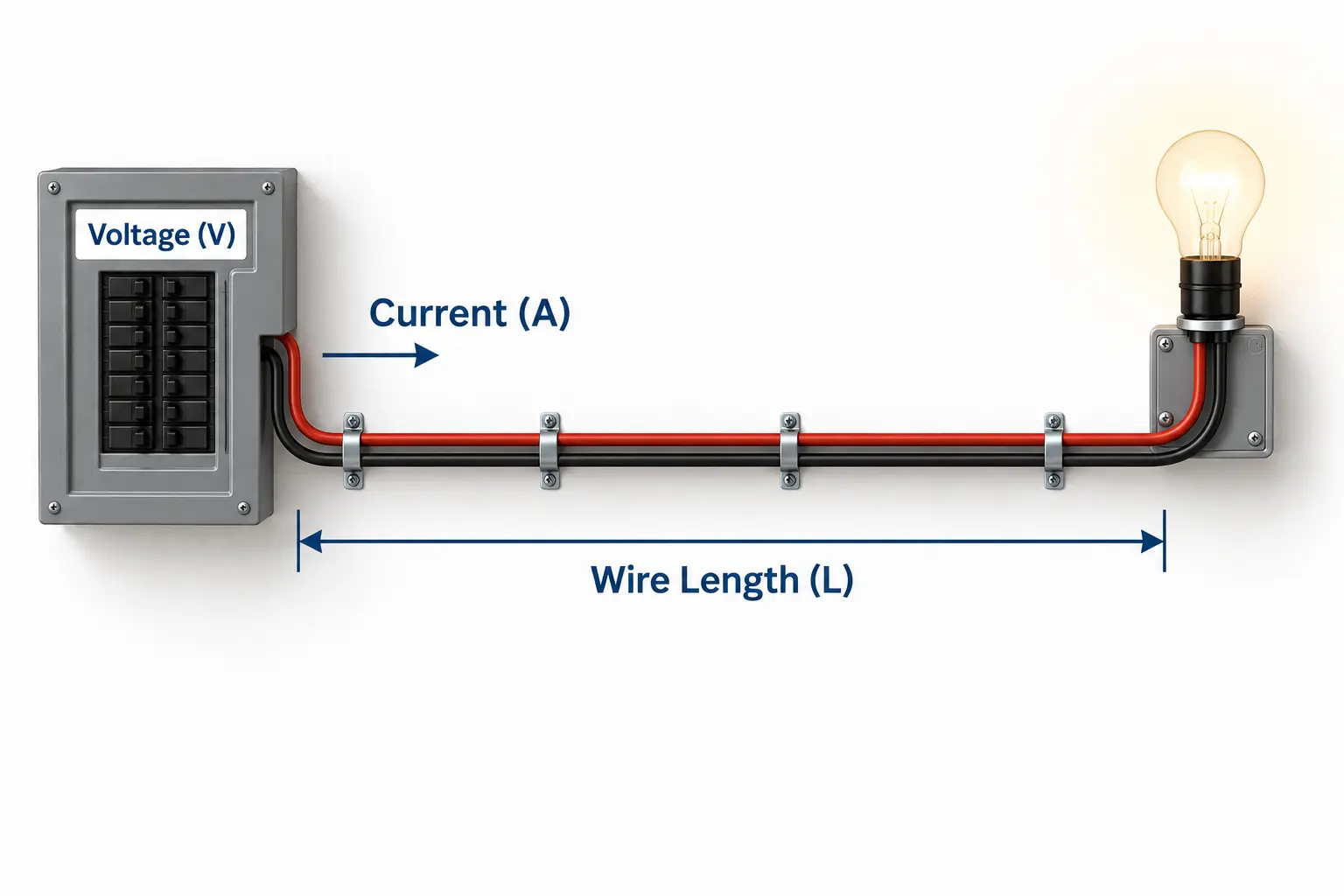
Voltage drop is the reduction in voltage that occurs as electrical current travels through a conductor because the conductor has electrical resistance.
The voltage available at the load can therefore be lower than the voltage supplied to the circuit. The amount of voltage drop depends on factors including current, conductor resistance, wire size, conductor material, and conductor length.
This calculator estimates voltage drop from the electrical and conductor parameters supported by the tool.
How Voltage Drop Is Calculated
The basic electrical relationship used to calculate voltage drop is current multiplied by resistance.
The CalConstruct calculator determines conductor resistance from the selected conductor material, wire gauge, and conductor length, then uses that resistance with the entered current to calculate the voltage drop.
The calculator uses the resistance characteristics and wire-area values defined by its implementation. It supports copper and aluminum conductors and wire gauges 4, 6, 8, 10, 12, and 14 AWG.
Voltage Drop = Current × Resistance
Voltage Drop Formula
For the supported wire sizes, the calculator determines resistance using the conductor material's resistance constant, conductor length, and the wire's circular-mil area.
The calculation uses the total conductor path length by applying the circuit length in both directions.
For a selected material and wire gauge, resistance is calculated from the implementation's material constant and circular-mil wire area. The resulting resistance is then multiplied by current.
Resistance = (K × Length × 2) ÷ Wire Area
Factors That Affect Voltage Drop
Several electrical and conductor characteristics affect the amount of voltage lost through a wire.
- Circuit voltage: The starting circuit voltage provides the reference for calculating the percentage of voltage lost.
- Current: For a given conductor resistance, increasing current increases voltage drop.
- Wire size: Wire size affects the conductor's circular-mil area and therefore affects its calculated resistance.
- Wire length: A longer conductor increases the calculated resistance when the other conductor characteristics remain the same.
- Conductor material: Copper and aluminum have different resistance characteristics, so changing the selected material changes the calculated result.
Voltage Drop in Wire
Voltage drop is commonly considered when evaluating electrical circuits with longer wire runs or significant current loads.
For the same current and conductor material, changing the wire gauge changes the calculated resistance and therefore changes voltage drop.
Likewise, increasing conductor length increases the calculated resistance and voltage drop when the other inputs remain unchanged.
The calculator can be used to compare different supported combinations of wire size, length, current, and conductor material.
Voltage Drop and Wire Size
Wire size is an important variable in a voltage-drop calculation because the calculator uses the circular-mil area associated with the selected wire gauge.
For the same current, length, and conductor material, a larger supported conductor has a larger circular-mil area and therefore a lower calculated resistance.
Use the calculator's wire-gauge selector to compare the supported conductor sizes.
Resistance = (K × Length × 2) ÷ Wire Area
Voltage Drop and Wire Length
Wire length directly affects the calculated conductor resistance.
As conductor length increases, resistance increases when the material and wire gauge remain unchanged. Because voltage drop is current multiplied by resistance, a longer conductor produces a greater calculated voltage drop under otherwise equivalent conditions.
Enter the conductor length represented by the circuit you are evaluating.
Voltage Drop and Conductor Material
The calculator supports two conductor materials: copper and aluminum.
The two materials use different resistance constants in the calculation, so selecting a different conductor material changes the calculated resistance and voltage drop.
Select the material that corresponds to the conductor being evaluated rather than assuming that both materials produce the same result.
Understanding the Voltage Drop Result
The calculator provides three related results: voltage drop, remaining voltage, and voltage drop percentage.
Voltage drop is the calculated amount of voltage lost through the conductor.
Remaining voltage is the circuit voltage after subtracting the calculated voltage drop.
Voltage drop percentage expresses the calculated voltage loss relative to the entered circuit voltage.
Remaining Voltage = Circuit Voltage − Voltage Drop
Voltage Drop Percentage
Voltage drop percentage expresses the calculated voltage loss as a percentage of the entered circuit voltage.
A higher voltage drop produces a higher percentage when the circuit voltage remains unchanged.
The percentage is calculated from the voltage-drop result and the circuit voltage entered into the calculator.
Voltage Drop Percentage = (Voltage Drop ÷ Circuit Voltage) × 100
DC Voltage Drop
DC voltage-drop calculations are a common use case for voltage-drop calculators.
This calculator provides a mathematical voltage-drop calculation from voltage, current, conductor length, wire gauge, and conductor material. It does not include a dedicated AC/DC selector.
The calculation should therefore be understood in terms of the electrical parameters entered rather than assuming additional AC-specific or DC-specific features that are not present in the interface.
Voltage Drop for Electrical Projects
Voltage-drop calculations can be relevant when evaluating electrical wiring over longer distances or comparing different conductor configurations.
The calculator is intended to perform the mathematical calculation from its supported inputs.
A voltage-drop result should not be treated as a complete electrical design, installation approval, or determination of whether a particular wiring configuration is appropriate for a project.
Why Input Accuracy Matters
A voltage-drop calculation is only as useful as the values entered into it.
Pay particular attention to the circuit voltage, current, wire gauge, conductor length, and conductor material.
Use the wire gauge that corresponds to the conductor being evaluated and enter the conductor length consistently.
If comparing configurations, change one relevant input at a time so the effect of that variable is easier to understand.
Voltage Drop vs. Wire Ampacity
Voltage drop and wire ampacity are related to electrical conductor selection but represent different calculations.
Voltage drop describes the reduction in voltage caused by conductor resistance.
Ampacity concerns how much current a conductor can safely carry under specified conditions.
This calculator calculates voltage drop. It does not calculate ampacity or determine whether a conductor is safely sized for a particular installation.
Voltage Drop and Electrical Code Requirements
A calculated voltage drop does not by itself establish whether an electrical installation complies with applicable electrical codes or local requirements.
Electrical installations can involve additional factors such as conductor installation conditions, circuit protection, equipment requirements, and jurisdiction-specific regulations.
Use this calculator as a calculation tool rather than as a code-compliance determination.
Checking a Voltage Drop Calculation
You can verify the basic calculation by first determining the wire area and resistance used for the selected conductor material and wire gauge.
Then multiply the calculated resistance by the entered current to obtain voltage drop.
Subtract the voltage drop from the circuit voltage to obtain remaining voltage.
Finally, divide the voltage drop by the circuit voltage and multiply by 100 to obtain the voltage drop percentage.
Voltage Drop = Current × Resistance
Voltage Drop Calculation Quick Reference
| Calculation | Formula |
|---|---|
| Voltage drop | Current × Resistance |
| Conductor resistance | (K × Length × 2) ÷ Wire Area |
| Remaining voltage | Circuit Voltage − Voltage Drop |
| Voltage drop percentage | (Voltage Drop ÷ Circuit Voltage) × 100 |
Internal Calculator Resources
CalConstruct includes other calculators for construction and project measurements. Use them when a project requires a different type of calculation.
For general construction volume calculations, use the Cubic Feet Calculator or Cubic Yard Calculator.
For lumber volume, use the Board Foot Calculator.
For stair dimensions, use the Stair Calculator.