
Gravel Calculator
Calculate the amount of gravel you need based on your project dimensions and depth.
How to Use This Calculator
- 1Measure the length of the area you want to cover.
- 2Measure the width of the area.
- 3Determine the depth of gravel you want to install.
- 4Enter the measurements into the calculator and select the appropriate units.
- 5Click Calculate to see the estimated gravel volume.
- 6Use the calculated volume to understand how much material your project requires in cubic feet or cubic yards.
Common Uses
- Gravel driveways
- Paths and walkways
- Landscaping projects
- Garden beds and borders
- Other rectangular areas requiring a gravel layer
How Much Gravel Do I Need?
The amount of gravel you need depends on the size of the area and the depth of the gravel layer. For a rectangular area, multiply the length by the width to find the area, then multiply that area by the gravel depth to find the volume.
Once the volume is calculated, it can be expressed in cubic feet or converted to cubic yards. The deeper the gravel layer, the more material the project requires.
How to Calculate How Much Gravel You Need
Start by measuring the length and width of the area in compatible units. Multiply those measurements to determine the area, then multiply the area by the gravel depth to determine the volume.
For measurements in feet, the basic calculation is length × width × depth. The resulting volume is expressed in cubic feet when all three dimensions are in feet.
If your depth is measured in inches, convert it to feet before multiplying. Divide the depth in inches by 12 to get the equivalent depth in feet.
Volume in Cubic Feet = Length × Width × Depth
Gravel Calculator Formula
The basic gravel volume formula for a rectangular area is to multiply the length, width, and depth.
When length and width are measured in feet and depth is converted to feet, the result is cubic feet.
To convert the volume to cubic yards, divide the calculated volume by 27 because one cubic yard contains 27 cubic feet.
Volume = Length × Width × Depth
How Many Cubic Yards of Gravel Do I Need?
Gravel is commonly purchased or delivered in cubic yards for larger landscaping and construction projects. To determine the number of cubic yards required, calculate the project's volume in cubic feet and divide that result by 27.
For example, if an area requires 81 cubic feet of gravel, divide 81 by 27 to get 3 cubic yards. This is the base volume before accounting for any additional material that may be needed because of project conditions.
Cubic Yards = Cubic Feet ÷ 27
Gravel Calculator for Square Feet
If you already know the area in square feet and the gravel depth in inches, you can calculate cubic yards directly.
The shortcut formula is useful when the square footage of the project is already known and you only need to account for the depth of the gravel layer.
The number 324 comes from converting inches to feet and cubic feet to cubic yards: 12 × 27 = 324.
For example, a 1,000-square-foot area with 3 inches of gravel requires approximately 9.26 cubic yards based on the base volume calculation.
Cubic Yards = Square Feet × Depth in Inches ÷ 324
Gravel Calculation Example
Suppose you have a rectangular area that is 20 feet long, 10 feet wide, and 3 inches deep.
First calculate the area: 20 × 10 = 200 square feet.
Next convert the depth to feet: 3 ÷ 12 = 0.25 feet.
Calculate the volume: 200 × 0.25 = 50 cubic feet.
Finally, convert cubic feet to cubic yards: 50 ÷ 27 = approximately 1.85 cubic yards.
Therefore, the base gravel volume for this area is approximately 1.85 cubic yards.
50 ÷ 27 = approximately 1.85 cubic yards
How Does Gravel Depth Affect the Amount Needed?
Gravel depth has a direct effect on the amount of material required. If the length and width remain the same, increasing the depth increases the volume proportionally.
For example, doubling the depth of a gravel layer doubles the calculated volume when the covered area remains unchanged.
This is why entering the intended gravel depth is one of the most important steps when using a gravel calculator.
Gravel Calculator for Driveways
A gravel driveway can be estimated by measuring its length, width, and planned gravel depth. Enter those dimensions into the calculator to determine the base volume of gravel required.
For a rectangular driveway, the volume is calculated by multiplying the length by the width and depth.
Once the volume is known, it can be expressed in cubic feet or cubic yards.
Driveways may involve multiple layers, changing widths, slopes, drainage features, or different aggregate materials. The basic rectangular calculation should therefore be treated as a volume estimate for the dimensions entered rather than a complete driveway construction plan.
Driveway Volume = Length × Width × Depth
Gravel for Paths and Walkways
Gravel is commonly used for garden paths, walkways, and other pedestrian areas. To estimate the material volume, measure the length and width of the area and enter the intended gravel depth.
The same basic volume calculation applies: length × width × depth.
If the path is not rectangular, divide it into simpler measurable sections and calculate the sections separately where necessary.
Length × Width × Depth = Volume
Gravel for Landscaping Projects
Gravel can be used around planting beds, borders, pathways, drainage areas, and other landscaping projects. The amount required depends primarily on the area being covered and the depth of the gravel layer.
For a rectangular landscaping area, enter the length, width, and depth into the calculator to estimate the base material volume.
Pea Gravel Calculator
Pea gravel can be calculated using the same basic volume method as other loose aggregate materials. Measure the area you want to cover and determine the depth of the pea gravel layer.
For a rectangular area, multiply the length, width, and depth to calculate the volume.
The resulting volume can be converted to cubic yards by dividing cubic feet by 27.
The volume calculation does not depend on whether the material is pea gravel, crushed gravel, or another aggregate. Material type becomes especially important when converting volume to weight because different materials can have different densities.
Volume = Length × Width × Depth
Crushed Gravel Calculator
Crushed gravel and crushed stone can be estimated by volume using the same length × width × depth calculation used for other rectangular gravel projects.
Enter the dimensions of the area and the required depth to calculate the base volume. If you need to convert that volume into weight, the density of the specific material must also be known.
Because crushed aggregates can vary in density, a volume calculation should not automatically be treated as a fixed tonnage.
How to Calculate Gravel in Tons
Gravel can be purchased by volume or by weight. Cubic yards describe the amount of space the material occupies, while tons describe its weight.
To convert a gravel volume into tons, you need the density of the particular material.
If volume is measured in cubic yards and density is expressed in tons per cubic yard, multiply the cubic-yard volume by the material density.
Density is not universal. Pea gravel, crushed stone, river rock, and other aggregates can have different densities, and moisture and material conditions can also affect weight.
For this reason, use the supplier's stated density when converting a CalConstruct volume result into tons.
Tons = Cubic Yards × Density
Cubic Feet vs. Cubic Yards of Gravel
Cubic feet and cubic yards are both measurements of volume. The difference is their scale.
One cubic yard equals 27 cubic feet. Cubic feet can be useful when working through the calculation manually, while cubic yards are commonly used when discussing larger quantities of bulk landscape materials.
If you know the volume in cubic feet, divide by 27 to convert it to cubic yards.
How to Measure an Area for Gravel
Before using a gravel calculator, measure the area that will be covered and determine the depth of the material.
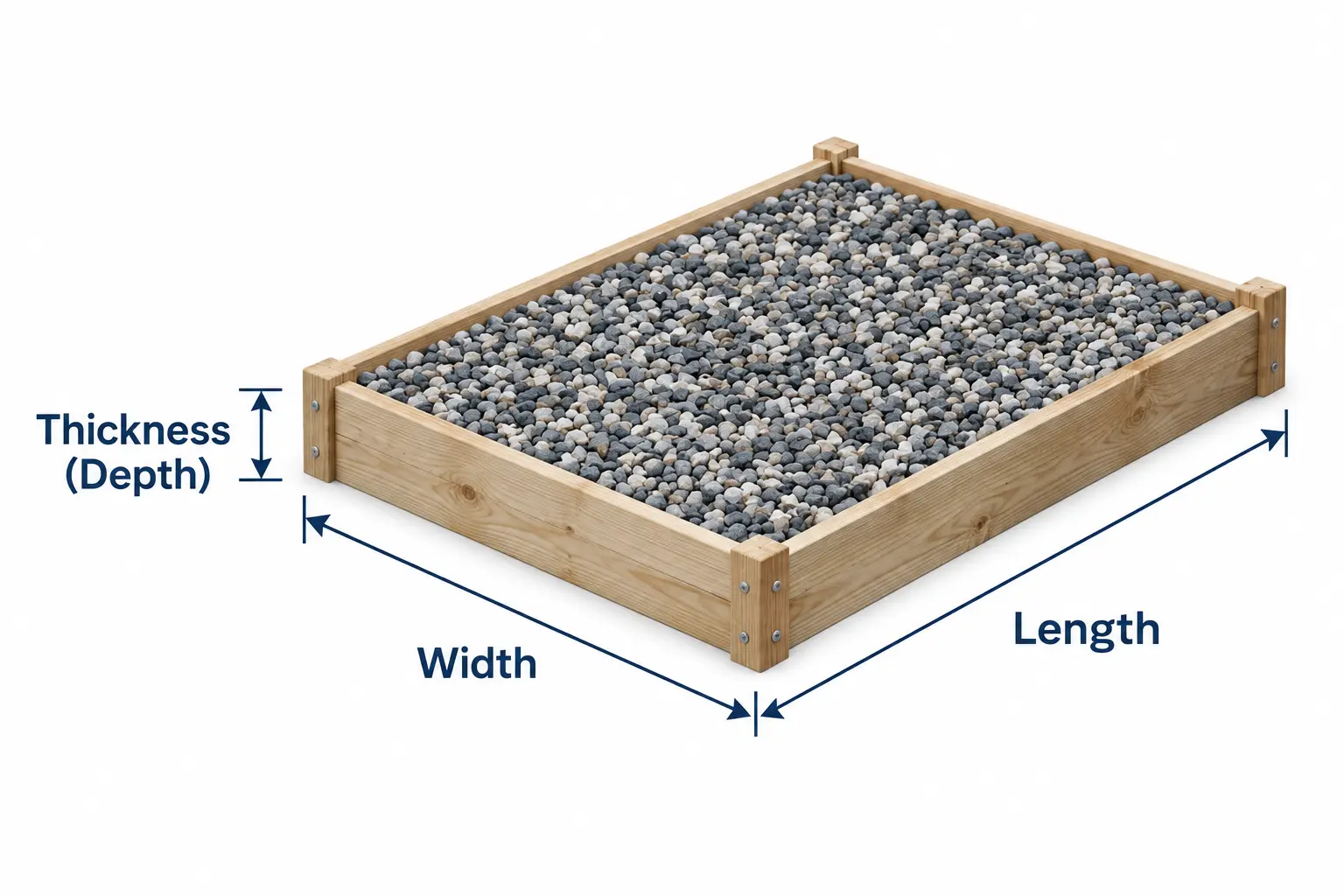
For a rectangular area, you need three measurements:
- Length: the distance from one end of the area to the other.
- Width: the distance across the area.
- Depth: how thick the gravel layer will be.
Common Gravel Calculation Mistakes
A few common mistakes can lead to incorrect volume estimates or confusing results.
- Using the wrong depth: Gravel quantity is directly affected by depth. Make sure the depth you enter represents the layer you actually intend to install.
- Mixing units: A depth measured in inches must be converted appropriately when manually calculating volume with dimensions measured in feet.
- Confusing square feet with cubic feet: Square feet measure area. Cubic feet measure volume. A gravel calculation needs both the covered area and the material depth to determine volume.
- Confusing cubic feet with cubic yards: One cubic yard contains 27 cubic feet. Dividing cubic feet by 27 converts the volume to cubic yards.
- Assuming every gravel type weighs the same: Different aggregates can have different densities, so a cubic-yard quantity should not automatically be converted to a fixed number of tons.
How to Check a Gravel Calculator Result
You can verify a rectangular gravel calculation manually by following three steps.
First, calculate the area by multiplying length × width. This gives the covered area in square feet when the measurements are in feet.
Next, calculate the volume by multiplying the square footage by the depth in feet. This gives the volume in cubic feet.
Finally, convert cubic feet to cubic yards by dividing by 27.
If your manual result is substantially different from the calculator result, check that the dimensions, units, and depth were entered correctly.
Cubic Feet ÷ 27 = Cubic Yards
Gravel Calculation Quick Reference
Use these formulas when checking a rectangular gravel calculation manually or comparing volume measurements.
| Calculation | Formula |
|---|---|
| Area | Length × Width |
| Depth in feet | Depth in inches ÷ 12 |
| Volume | Length × Width × Depth |
| Cubic yards | Cubic feet ÷ 27 |
| Tons | Cubic yards × Material Density |
Gravel Types and Volume Calculations
Gravel products can differ in size, shape, composition, and density. Examples include pea gravel, crushed gravel, crushed stone, and other aggregate materials.
The volume required for a rectangular area is still calculated from length, width, and depth. The main difference appears when converting that volume into weight because different materials can have different densities.
When purchasing gravel by weight, use the density provided by the material supplier rather than assuming every gravel product weighs the same amount per cubic yard.
Gravel Waste, Settling, and Compaction
The calculated volume represents the geometric volume of the area based on the dimensions entered. Real gravel projects can involve settling, compaction, uneven subgrades, spillage, and measurement differences.
The amount of additional material required depends on the project and material. If you need to account for an additional allowance, apply that adjustment separately rather than assuming the base calculator result already includes it.
Internal Calculator Resources
If you want to work specifically with cubic-yard measurements, use the Cubic Yard Calculator.
For calculations specifically involving cubic feet, use the Cubic Feet Calculator.
For concrete projects, use the Concrete Calculator to estimate concrete volume and supported material quantities.
For landscaping projects using mulch instead of gravel, see the Mulch Calculator.