
Board Foot Calculator
Calculate the board feet of lumber using its length, width, and thickness.
Related Calculators
How to Use This Calculator
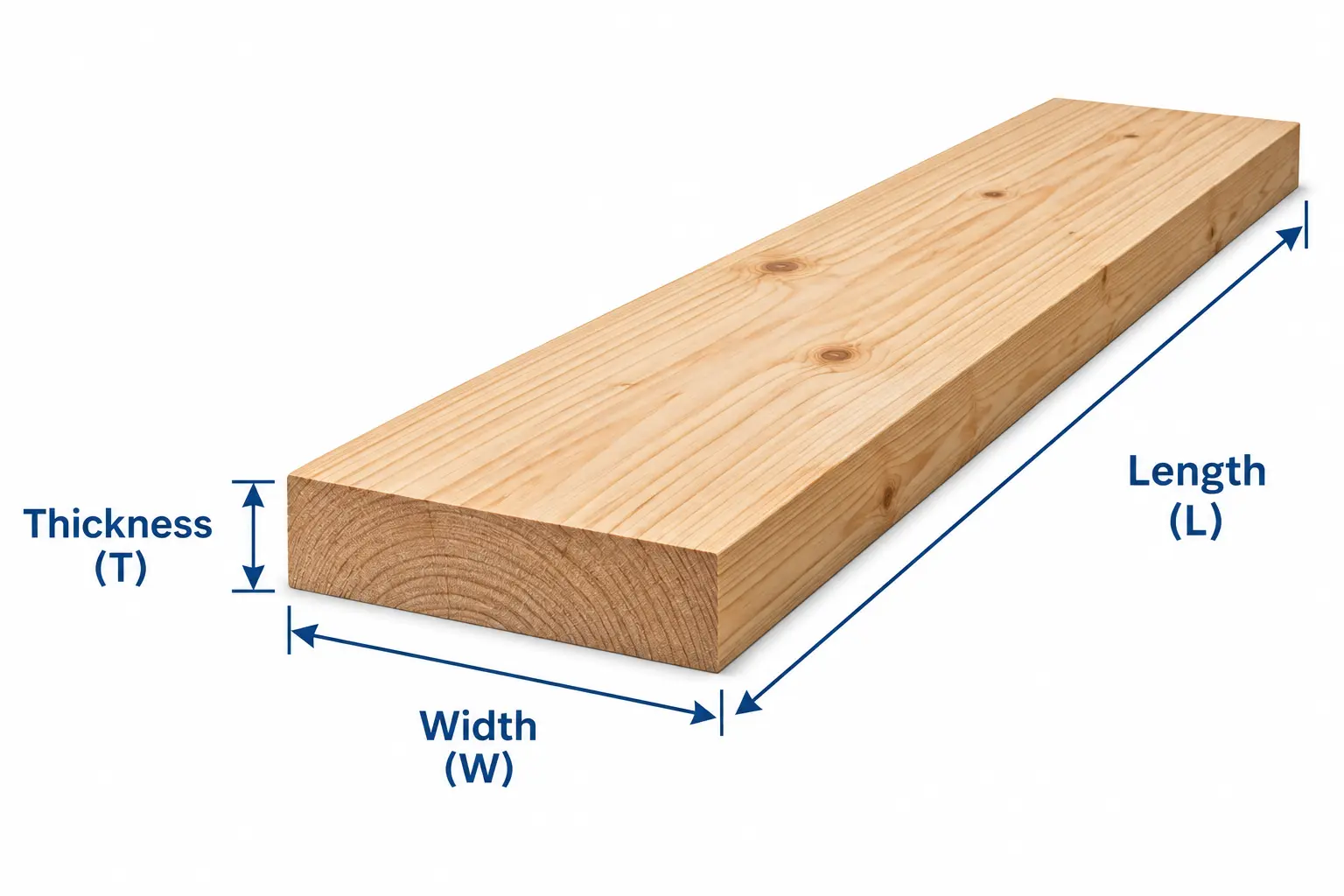
- 1Measure the thickness of the board.
- 2Measure the width.
- 3Measure the length.
- 4Enter the dimensions into the calculator.
- 5Select the appropriate supported units.
- 6Click Calculate.
- 7Review the calculated board-foot volume.
Common Uses
- Rough lumber volume
- Lumber quantity estimation
- Comparing board dimensions
- Woodworking projects
- Lumber purchasing calculations
- Board-foot measurements
- General lumber volume calculations
What Is a Board Foot?
A board foot is a unit of lumber volume. One board foot represents a piece of wood measuring 1 foot long, 1 foot wide, and 1 inch thick.
Because board feet measure volume, the calculation accounts for the length, width, and thickness of the lumber rather than length alone.
One board foot is equal to 144 cubic inches.
For example, a board measuring 1 foot long, 12 inches wide, and 1 inch thick contains 1 board foot.
1 board foot = 144 cubic inches
How to Calculate Board Feet
For lumber dimensions measured in inches for thickness and width and feet for length, multiply the thickness, width, and length, then divide by 12.
For example, a board that is 2 inches thick, 6 inches wide, and 10 feet long contains 10 board feet.
The calculator performs the applicable unit conversions based on its supported inputs.
Board Feet = Thickness × Width × Length ÷ 12
Board Foot Calculator Formula
The standard board-foot formula uses thickness and width in inches and length in feet.
The formula works because a board foot represents 144 cubic inches, while a length measured in feet contributes 12 inches to the calculation.
If all three dimensions are first converted to inches, the equivalent formula divides the resulting cubic-inch volume by 144.
Both approaches produce the same board-foot measurement when the dimensions are converted consistently.
Board Feet = Thickness (in) × Width (in) × Length (ft) ÷ 12
Board Feet of Lumber
Board feet are commonly used when discussing lumber volume. A board-foot measurement allows different pieces of lumber to be compared based on their total volume rather than simply their length or surface area.
For example, a thick, narrow board and a thin, wide board can have different dimensions but similar total board footage.
This makes board feet useful when estimating and comparing the volume of rough lumber.
The board-foot calculation describes volume; it does not automatically determine the number of physical boards required for a particular construction project.
How Many Board Feet Do I Need?
The total board footage depends on the dimensions and quantity of the lumber being considered.
For one board, calculate the board footage using thickness × width × length ÷ 12.
If several boards have identical dimensions, you can calculate the board footage of one board and multiply it by the number of boards.
If boards have different dimensions, calculate each group separately and add the results.
The current calculator should only be described as calculating multiple-board quantities if the interface actually includes a quantity input.
Total Board Feet = Board Feet per Board × Number of Boards
Board Feet vs. Linear Feet
Board feet and linear feet measure different things.
Linear feet measure length only, while board feet measure lumber volume by incorporating length, width, and thickness.
For example, two boards can both be 10 linear feet long while having very different board-foot measurements if their widths or thicknesses differ.
A linear-foot measurement alone cannot determine board feet without knowing the board's width and thickness.
Board Feet = Length × Width × Thickness
Board Feet vs. Cubic Feet
Both board feet and cubic feet describe volume, but they use different conventions.
A board foot represents 144 cubic inches, while a cubic foot represents 1,728 cubic inches.
Therefore, one cubic foot contains 12 board feet, and one board foot equals one-twelfth of a cubic foot.
Board feet are especially useful for lumber because the unit is based on the traditional dimensions used to describe boards.
For general three-dimensional volume calculations, use the Cubic Feet Calculator.
1 cubic foot = 12 board feet
Board Feet and Lumber Dimensions
Lumber is often described using nominal dimensions, but the actual dimensions of a piece can differ from its nominal size.
For a board-foot calculation, use the dimensions that correspond to the lumber measurement you are trying to calculate.
Do not automatically assume that a board described commercially by a particular nominal size has exactly those physical dimensions.
When estimating lumber volume, clearly distinguish between nominal lumber descriptions and actual measured dimensions.
Board Foot Calculator for Lumber
The board-foot calculation is useful for many lumber-related measurements.
Common applications include estimating rough lumber volume, comparing lumber quantities, calculating board footage for groups of boards manually, estimating lumber volume before purchasing, and comparing different board dimensions.
The calculator determines board footage from the dimensions entered.
It does not automatically determine whether a particular lumber size is appropriate for a structural application.
Board Foot Calculator for Multiple Boards
If several boards have identical dimensions, the total board footage can be calculated by multiplying the board-foot measurement of one board by the number of boards.
For example, if one board contains 8 board feet and there are 10 identical boards, the total is 80 board feet.
If the boards have different dimensions, calculate each group separately and add the results.
Only describe a quantity-based calculation as part of the calculator itself if the current implementation provides a quantity input.
Total Board Feet = Board Feet per Board × Number of Boards
Calculating Board Feet From Inches
Because board-foot calculations are based on lumber dimensions, measurements are often given in inches.
When thickness and width are measured in inches and length is measured in feet, use the standard board-foot formula.
If all three dimensions are measured in inches, multiply the three dimensions and divide by 144.
For example, a board measuring 2 inches thick, 8 inches wide, and 72 inches long contains 8 board feet.
The important part is keeping the units consistent with the formula being used.
Board Feet = Thickness (in) × Width (in) × Length (in) ÷ 144
Board Foot Calculation Examples
The following examples demonstrate how the standard board-foot formula works with common lumber dimensions.
A 1 × 6 × 10 board contains 5 board feet.
A 2 × 8 × 12 board contains 16 board feet.
A 2 × 6 × 8 board contains 8 board feet.
These examples demonstrate the calculation and should not be presented as purchasing recommendations.
| Thickness | Width | Length | Board Feet |
|---|---|---|---|
| 1 in | 6 in | 10 ft | 5 |
| 2 in | 8 in | 12 ft | 16 |
| 2 in | 6 in | 8 ft | 8 |
Common Board Foot Calculation Mistakes
- Confusing board feet with linear feet: Linear feet measure length only. Board feet incorporate thickness, width, and length.
- Using the wrong units: The standard formula expects thickness and width in inches and length in feet. Convert other unit combinations before applying the formula.
- Using nominal dimensions without checking: Commercial lumber sizes do not necessarily equal the actual measured dimensions of the board.
- Forgetting board thickness: Board footage is a volume measurement, so thickness is essential to the calculation.
- Treating board feet as a count of boards: A board-foot measurement represents volume. Determining the number of physical boards also requires the dimensions and quantity of those boards.
- Rounding too early: Keep enough precision during the calculation and round the final board-foot result as appropriate.
Checking a Board Foot Calculation Manually
You can verify a board-foot calculation with the standard formula.
For example, consider a board that is 2 inches thick, 6 inches wide, and 10 feet long.
Multiply the dimensions: 2 × 6 × 10 = 120.
Then divide by 12: 120 ÷ 12 = 10 board feet.
If the calculator produces a different result, check the dimensions and units entered.
Board Feet = Thickness × Width × Length ÷ 12
Board Foot Quick Reference
| Calculation | Formula |
|---|---|
| Standard board feet | Thickness (in) × Width (in) × Length (ft) ÷ 12 |
| All dimensions in inches | Thickness × Width × Length ÷ 144 |
| Cubic inches to board feet | Cubic Inches ÷ 144 |
| Cubic feet to board feet | Cubic Feet × 12 |
| Board feet to cubic feet | Board Feet ÷ 12 |
Board Feet and Lumber Pricing
Board feet are sometimes used as a basis for describing lumber prices.
A price expressed per board foot is different from a price expressed per physical board or per linear foot.
The general relationship for a price-per-board-foot calculation is board feet multiplied by the price per board foot.
However, do not imply that the CalConstruct calculator provides lumber pricing unless the current implementation actually includes a price input and cost result.
For actual purchasing, lumber prices can vary by species, grade, dimensions, supplier, location, and market conditions.
Lumber Cost = Board Feet × Price per Board Foot
Log Board Foot Calculations
Board-foot measurements can also be discussed in relation to logs, but logs are not rectangular boards.
A log requires a different geometric approach and may use log-scaling conventions rather than the simple rectangular board-foot formula.
Do not describe the current calculator as a log board foot calculator unless the implementation explicitly supports logs.
For a standard rectangular board, use the standard board-foot formula.
Board Feet = Thickness × Width × Length ÷ 12
Measuring Lumber for a Board Foot Calculation
Before calculating board footage, measure the board thickness, width, and length and record the units used.
Enter the dimensions into the calculator and select the appropriate supported units.
For rough or irregular lumber, measurements should represent the dimensions relevant to the volume being calculated.
Use the actual dimensions required by the calculation rather than automatically substituting nominal lumber dimensions.
- Thickness: Measure the thickness of the board.
- Width: Measure the board's width.
- Length: Measure the board's length.
Internal Calculator Resources
For general volume calculations expressed in cubic feet, use the Cubic Feet Calculator.
For larger material volumes measured in cubic yards, use the Cubic Yard Calculator.
If you need to calculate an area before working with lumber dimensions, use the Square Footage Calculator.
For stair-dimension calculations, use the Stair Calculator.