
Concrete Calculator
Calculate concrete volume in cubic feet and cubic yards, with an optional waste allowance.
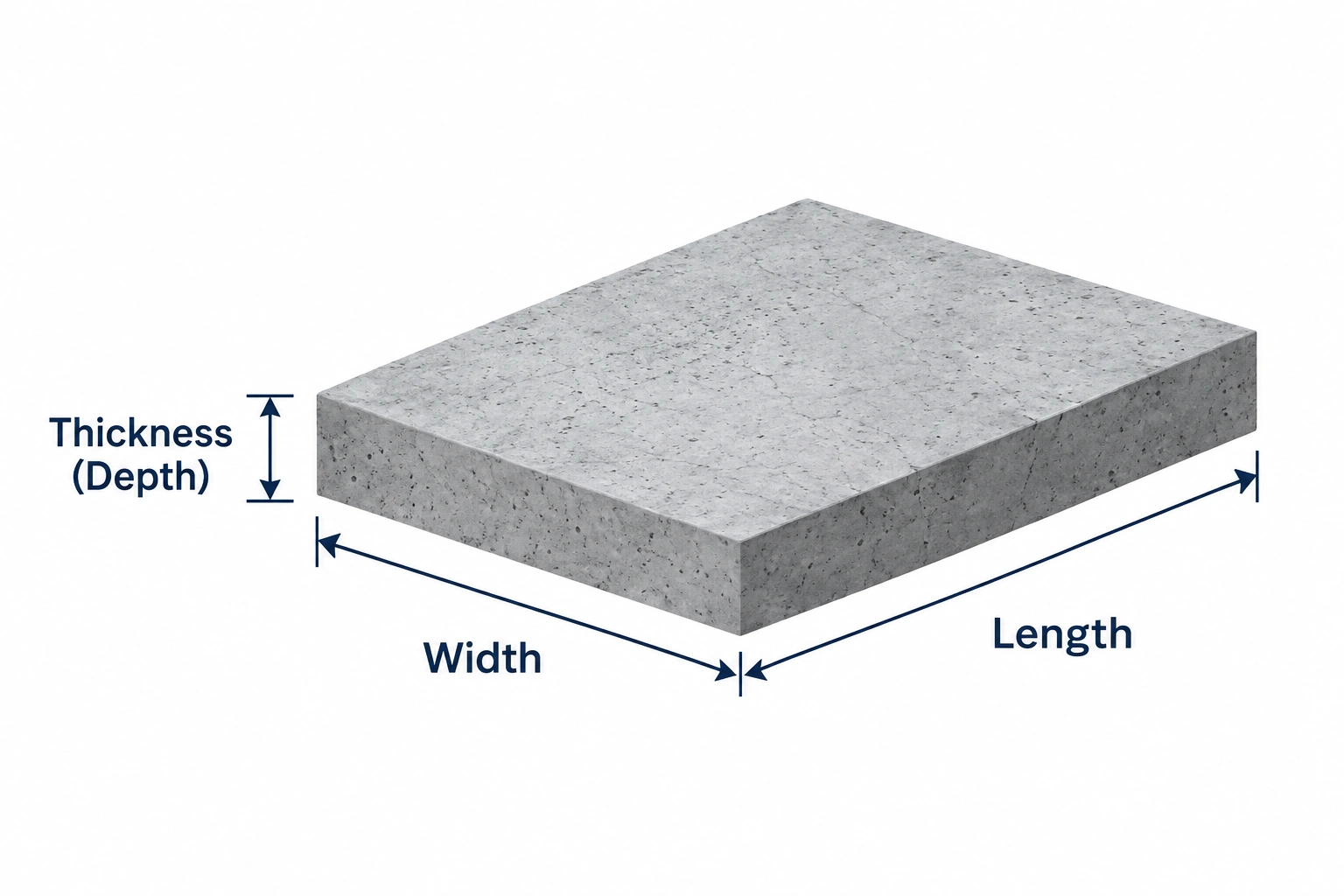
How to Use This Calculator
- 1Enter the length, width, and thickness or depth of your concrete area.
- 2Choose the appropriate unit for each measurement.
- 3Open Advanced Options if you need to account for waste or overage.
- 4Click Calculate to see the estimated concrete volume.
- 5Review the volume in cubic yards and cubic feet, including the adjusted values when waste is applied.
Common Uses
- Concrete slabs
- Patios and walkways
- Driveways
- Concrete pads
- Footings and foundations
How Much Concrete Do I Need?
The amount of concrete you need depends on the length, width, and thickness of the area you are filling. For a rectangular project, multiply those three measurements to find the volume. The result can then be expressed in cubic feet or cubic yards and used as the basis for estimating the amount of concrete required.
If your project has additional material loss from spillage, uneven surfaces, or measurement differences, use the waste or overage option to increase the calculated amount.
How to Calculate Concrete Volume
For a rectangular concrete project, calculate the base volume by multiplying the length by the width and the thickness or depth. The result represents the amount of space that needs to be filled with concrete.
If the dimensions are entered in feet, the result is in cubic feet. To convert cubic feet to cubic yards, divide the cubic-foot volume by 27.
Concrete Volume = Length × Width × Thickness
Concrete Calculation Example
Suppose you are calculating a rectangular concrete slab that is 10 feet long, 10 feet wide, and 4 inches thick.
First, convert the thickness from inches to feet: 4 inches ÷ 12 = 0.333 feet.
Then multiply the dimensions: 10 × 10 × 0.333 = approximately 33.33 cubic feet.
To convert the result to cubic yards, divide by 27: 33.33 ÷ 27 = approximately 1.23 cubic yards.
So a 10 × 10 foot area at 4 inches thick requires approximately 1.23 cubic yards of concrete before any waste or overage adjustment.
4 inches ÷ 12 = 0.333 feet
How Concrete Thickness Affects the Amount You Need
Thickness has a direct effect on the amount of concrete required. If the length and width stay the same, increasing the thickness increases the volume proportionally.
For example, a 10 × 10 foot area at 4 inches thick requires less concrete than the same 10 × 10 foot area at 6 inches thick because the second project contains more volume.
This is why entering the correct thickness is important when using a concrete volume calculator. A small difference in thickness across a large area can change the total amount of concrete required.
The calculator determines the quantity from the dimensions you enter. It does not determine the structurally appropriate thickness for a particular project.
How to Calculate Cubic Feet of Concrete
Cubic feet are a useful way to express the volume of a rectangular concrete project. When the length and width are measured in feet, convert the thickness or depth to feet before multiplying the dimensions.
For example, if a project is 12 feet long, 8 feet wide, and 4 inches thick, first convert 4 inches to feet: 4 ÷ 12 = 0.333 feet.
Then multiply the dimensions: 12 × 8 × 0.333 = approximately 32 cubic feet.
The calculator performs the necessary unit conversions when supported units are selected.
Cubic Feet = Length × Width × Thickness
How to Calculate Cubic Yards of Concrete
Concrete for larger projects is commonly discussed in cubic yards. Once you have the volume in cubic feet, divide it by 27 to convert it to cubic yards.
Since one cubic yard contains 27 cubic feet, this conversion allows the same project volume to be expressed in the unit commonly used for larger concrete quantities.
For example, if your project requires 54 cubic feet, divide 54 by 27 to get 2 cubic yards before applying any waste or overage adjustment.
Cubic Yards = Cubic Feet ÷ 27
Concrete Volume Conversions
These conversions are useful when checking a concrete calculation or comparing measurements expressed in different units.
| Measurement | Equivalent |
|---|---|
| 1 cubic yard | 27 cubic feet |
| 1 cubic foot | 1/27 cubic yard |
| 12 inches | 1 foot |
| 36 inches | 1 yard |
How Many Bags of Concrete Do I Need?
The number of concrete bags needed depends on the calculated concrete volume and the yield information for the specific bagged concrete product being used. Project dimensions determine the required volume, while the product's stated yield determines how much material each bag supplies.
This calculator currently focuses on calculating concrete volume in cubic feet and cubic yards. Use the calculated volume with the coverage or yield information provided for the concrete product you plan to use.
How the Concrete Bag Calculation Works
The general relationship between required concrete volume and bag quantity is to divide the required volume by the volume supplied by each bag.
Because bag sizes and yields can differ, the number of bags cannot be determined from project dimensions alone. The applicable bag yield must be known before converting a volume estimate into a bag count.
Bag quantities are normally rounded to whole bags because a project cannot be completed by purchasing a fraction of a bag.
Bags Needed = Required Volume ÷ Volume Supplied per Bag
Concrete Volume vs. Number of Bags
Concrete volume and bag quantity describe the same material requirement in different ways. Volume tells you how much space the concrete must fill, while a bag estimate translates that volume into individual bags based on the yield of the product being used.
This is why the volume calculation is the foundation of a concrete bag calculation. If the project dimensions change, the required volume changes, and the estimated number of bags changes with it.
Account for Concrete Waste and Overage
The calculated volume represents the concrete required for the dimensions you enter. In a real project, some additional material may be useful to account for spillage, uneven surfaces, measurement differences, or other losses.
Use the waste or overage setting to increase the calculated requirement by the percentage you choose.
Adjusted Amount = Base Amount × (1 + Waste Percentage ÷ 100)
Why Add Waste or Overage to a Concrete Estimate?
The geometric volume of a project represents the amount of space calculated from its dimensions. Actual projects can require additional material because of spillage, uneven surfaces, measurement differences, or other conditions during a pour.
The Concrete Calculator includes a waste or overage option so you can increase the calculated requirement by a percentage you choose.
For example, if the calculated requirement is 2 cubic yards and a 10% overage is selected, the adjusted amount would be 2 × 1.10 = 2.20 cubic yards.
The additional amount is an allowance rather than part of the project's geometric volume.
2 × 1.10 = 2.20 cubic yards
Concrete Calculator for Slabs
A concrete slab calculation starts with three dimensions: length, width, and thickness. Multiplying these measurements gives the volume of concrete required to fill the rectangular space.
This makes the calculator useful for estimating concrete for rectangular slabs, pads, patios, walkways, and similar projects where the area and thickness can be measured.
When measuring an existing form or prepared area, use the dimensions of the space that will actually be filled with concrete.
This calculator estimates material quantity from the dimensions entered. It does not determine structural design requirements or the appropriate thickness for a particular building application.
Concrete Calculator for Patios and Pads
For a rectangular patio or concrete pad, measure the length and width of the area and determine the thickness or depth that will be filled. Enter those dimensions into the calculator to estimate the concrete volume.
The same basic calculation can be used for rectangular walkways and other flat concrete areas.
Concrete Calculator for Driveways
A rectangular driveway can be estimated by entering its length, width, and thickness. The calculator uses those dimensions to determine the volume of concrete required.
For driveways or other areas with changing widths, irregular shapes, slopes, thickened edges, or multiple sections, divide the project into measurable sections where appropriate and calculate each section separately.
How to Measure for a Concrete Calculation
Measure the length and width of the area that will be filled, then determine the thickness or depth. Keep your measurements consistent and use the calculator's unit selectors when entering them.
For a rectangular project, the three measurements needed are:
- Length: the long dimension of the area.
- Width: the other horizontal dimension.
- Thickness / Depth: how deep the concrete will be.
Common Concrete Calculation Mistakes
A few common mistakes can lead to incorrect volume estimates or confusing results.
- Using the wrong thickness: Thickness has a direct effect on volume. Make sure the thickness entered represents the actual depth you intend to fill.
- Mixing units: Inches and feet must be converted correctly when calculating manually. The calculator handles supported unit conversions for you.
- Forgetting waste or overage: The geometric calculation represents the dimensions entered. If additional material is needed for project conditions, use the waste or overage option rather than assuming the base volume includes extra material.
- Confusing cubic feet and cubic yards: Cubic feet and cubic yards measure the same type of volume at different scales. One cubic yard equals 27 cubic feet.
- Relying on a bag count without checking the product yield: Bag quantities depend on the yield information for the product being used. Different products can have different yields, so a bag estimate should be based on the specific product information.
How to Check Your Concrete Calculation
You can perform a quick manual check by calculating the rectangular volume separately. Multiply the length, width, and thickness after converting the measurements to compatible units.
Then convert cubic feet to cubic yards by dividing by 27. Compare that result with the calculator's volume result.
If you have applied a waste or overage percentage, remember that the adjusted amount will be greater than the base geometric volume.
Length × Width × Thickness = Cubic Feet
Concrete Calculator Formula
The basic concrete volume formula for a rectangular area is to multiply the length, width, and thickness or depth.
When the length and width are measured in feet and thickness is measured in inches, convert the thickness to feet before multiplying. The resulting volume is cubic feet.
To convert the result to cubic yards, divide the cubic-foot volume by 27.
If a waste or overage percentage is applied, the base volume is increased by the percentage entered in the calculator.
Volume = Length × Width × Thickness
Concrete Calculation Quick Reference
The calculator performs the applicable conversions and calculations automatically based on the measurements and settings provided.
| You want to calculate | Basic approach |
|---|---|
| Concrete volume | Length × Width × Thickness |
| Cubic feet | Calculate volume using compatible units |
| Cubic yards | Cubic feet ÷ 27 |
| Waste-adjusted quantity | Base quantity × (1 + waste %) |
| Bags needed | Required volume ÷ bag yield |