
Mulch Calculator
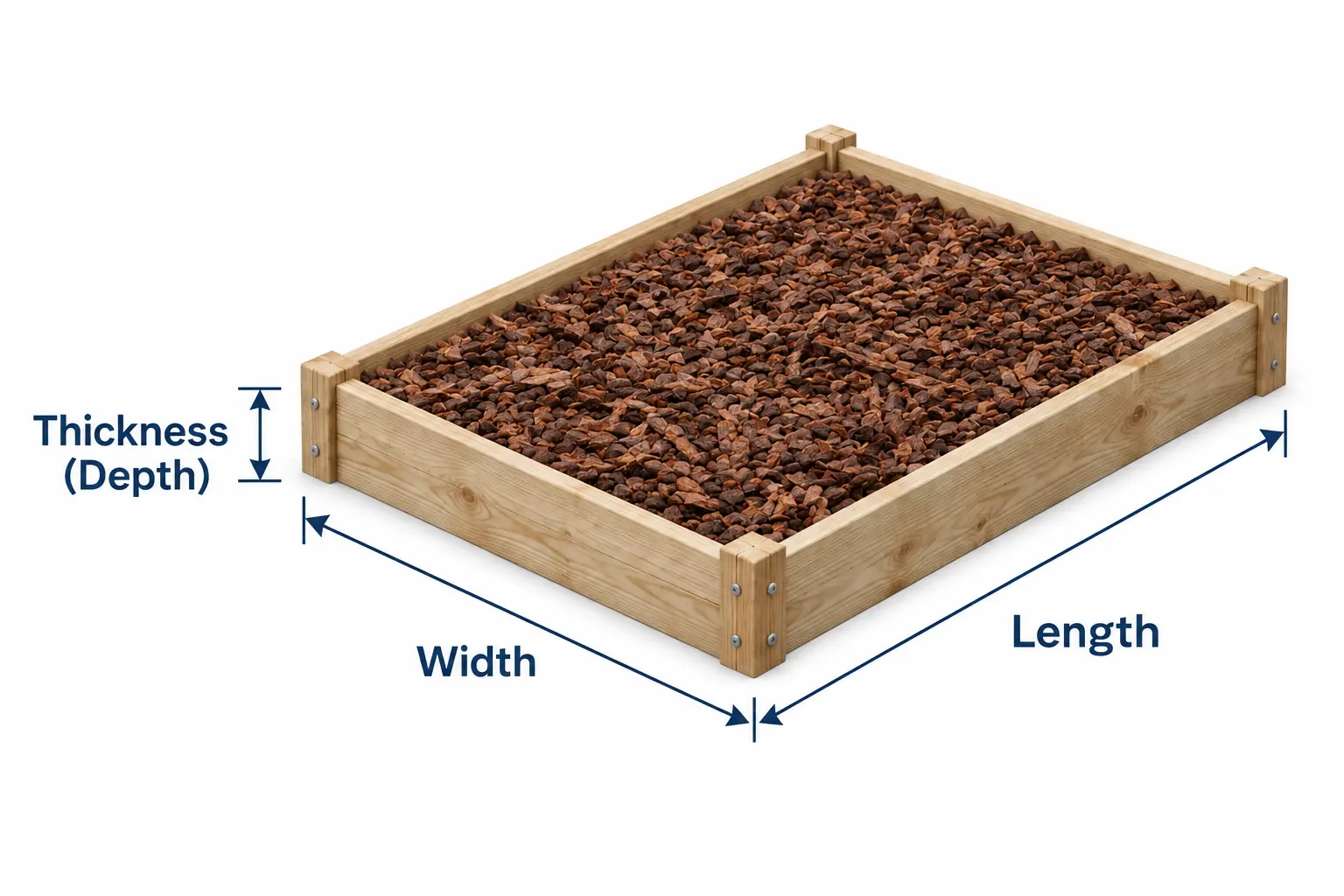
Calculate how much mulch you need based on your area and desired depth.
Related Calculators
How to Use This Calculator
- 1Measure the length of the area you want to cover.
- 2Measure the width of the area.
- 3Determine the depth of mulch you want to apply.
- 4Enter the measurements and select the appropriate units.
- 5Click Calculate to estimate the mulch volume required for the area.
- 6Review the calculated volume and use the result to plan the amount of mulch needed.
Common Uses
- Garden beds
- Landscaping areas
- Planting beds and borders
- Playground areas
- Other rectangular areas requiring a mulch layer
How Much Mulch Do I Need?
The amount of mulch you need depends on the size of the area and the depth of the mulch layer. For a rectangular area, multiply the length by the width to determine the area, then multiply that area by the mulch depth to calculate the volume.
The resulting volume can be expressed in cubic feet or converted to cubic yards. A deeper mulch layer requires more material for the same covered area.
How to Calculate How Much Mulch You Need
Start by measuring the length and width of the area you want to cover. Then determine how deep you want the mulch layer to be.
For measurements in feet, multiply the length, width, and depth to calculate the volume. The result is cubic feet when all three dimensions are expressed in feet.
To convert cubic feet to cubic yards, divide the result by 27.
Mulch Volume = Length × Width × Depth
Mulch Calculator Formula
The basic mulch volume formula for a rectangular area is to multiply the length by the width and depth.
If your length and width are measured in feet and your mulch depth is measured in inches, first convert the depth to feet.
Then calculate the volume in cubic feet and divide by 27 to convert the result to cubic yards.
Cubic Yards = (Length × Width × Depth in Inches) ÷ 324
Mulch Calculator for Square Feet
If you already know the area in square feet, you can calculate the required mulch volume by multiplying the square footage by the mulch depth.
When the depth is measured in inches, divide the square-foot area multiplied by the depth by 12 to get cubic feet.
To convert that result to cubic yards, divide by 27, which produces a combined divisor of 324.
This provides a quick way to estimate mulch when you already know the size of the planting bed, landscape area, or other space being covered.
Cubic Yards = Square Feet × Depth in Inches ÷ 324
Mulch Calculation Example
Suppose you have a rectangular garden bed that is 20 feet long and 10 feet wide, and you want to apply 3 inches of mulch.
First calculate the area: 20 × 10 = 200 square feet.
Convert the depth to feet: 3 ÷ 12 = 0.25 feet.
Calculate the volume: 200 × 0.25 = 50 cubic feet.
Convert to cubic yards: 50 ÷ 27 = approximately 1.85 cubic yards.
So the base volume for this example is approximately 1.85 cubic yards of mulch.
50 ÷ 27 = approximately 1.85 cubic yards
How Many Cubic Yards of Mulch Do I Need?
Mulch is often sold or delivered by cubic yard, especially when purchasing larger quantities for landscaping projects.
Once you calculate the volume in cubic feet, divide by 27 to convert it to cubic yards.
For example, 54 cubic feet of mulch equals 2 cubic yards.
The result represents the calculated volume based on the dimensions and depth you entered.
Cubic Yards = Cubic Feet ÷ 27
How Does Mulch Depth Affect the Amount Needed?
Mulch depth has a direct effect on the amount of material required. If the length and width remain the same, increasing the depth increases the volume proportionally.
For example, doubling the mulch depth doubles the calculated volume for the same area.
Because of this, the depth you enter should represent the layer you actually intend to install.
Mulch Coverage
Mulch coverage depends on both the amount of material available and the depth at which it is spread. The same quantity of mulch covers a larger area when spread more thinly and a smaller area when applied more deeply.
To calculate coverage, work backward from the same volume relationship by dividing the available volume by the depth.
Keep the units consistent when performing the calculation. There is no single coverage area for a cubic yard without specifying the depth.
Area = Volume ÷ Depth
Mulch Calculator for Garden Beds
Garden beds are one of the most common applications for mulch. Measure the length and width of the bed and determine the desired mulch depth.
For a rectangular bed, multiply the length, width, and depth to calculate the mulch volume.
If the bed has multiple rectangular sections, calculate each section separately and add the volumes together.
Length × Width × Depth = Mulch Volume
Mulch Calculator for Landscaping
Mulch is commonly used around trees, shrubs, planting beds, borders, and other landscaped areas. The amount required depends primarily on the area being covered and the depth of the mulch layer.
For a rectangular area, enter the length, width, and depth into the calculator to estimate the base mulch volume.
Rubber Mulch Calculator
Rubber mulch can be estimated using the same basic volume calculation when the project area and desired depth are known.
For a rectangular area, multiply the length, width, and depth to determine the volume.
The volume calculation is based on the dimensions of the area rather than the material name. However, product density, packaging, and coverage information can vary between rubber mulch products.
If purchasing rubber mulch by bags, use the coverage information provided for the specific product rather than assuming every bag covers the same area.
Volume = Length × Width × Depth
Playground Mulch Calculator
Playground areas can be estimated using the same basic volume calculation: determine the area being covered and multiply it by the planned mulch depth.
For playground projects, the required depth should not be chosen solely from a material calculator. Playground surfacing requirements can depend on the type of material, equipment height, site conditions, and applicable safety guidance.
Once the required depth has been established for the specific project, enter that depth into the calculator to estimate the corresponding material volume.
Volume = Length × Width × Depth
How Many Bags of Mulch Do I Need?
The number of mulch bags required depends on the volume of mulch in each bag and the coverage stated by the product manufacturer.
First calculate the required volume of mulch. Then compare that volume with the yield or coverage information provided on the product packaging.
Bag coverage can vary by product and by the depth at which the mulch is spread, so there is no single bag count that applies to every mulch product.
Bags Needed = Required Volume ÷ Volume Supplied per Bag
Does Mulch Type Affect the Calculation?
The basic geometric volume calculation is based on the size of the area and the depth of the mulch layer. It does not change simply because the material is wood mulch, rubber mulch, or another type of mulch.
What can change is how the material is sold, packaged, or converted between volume and weight. Product-specific coverage information should therefore be used when purchasing bagged mulch.
How to Calculate Mulch for an Irregular Area
If the area you want to mulch is not rectangular, divide it into smaller shapes that are easier to measure, such as rectangles. Calculate the volume for each section separately, then add the results together.
For example, an L-shaped garden bed can be divided into two rectangles and calculated as two separate sections.
Mulch Around a Circular Area
A circular planting area requires an area calculation before the mulch volume can be determined.
The area of a circle is calculated by multiplying π by the radius squared. Then multiply the resulting area by the mulch depth to determine volume.
The current calculator should only be described as supporting the shapes actually provided by its interface. For a circular area, calculate the circular area separately before applying the depth.
Area = π × Radius²
Common Mulch Calculation Mistakes
A few common mistakes can lead to incorrect mulch volume estimates or confusing results.
- Using the wrong depth: The depth has a direct effect on the required volume. Make sure the depth you enter represents the intended mulch layer.
- Mixing inches and feet: If the length and width are in feet but the depth is in inches, convert the depth to feet before multiplying.
- Confusing square feet with cubic feet: Square feet measure the area being covered. Cubic feet measure the volume of mulch needed. Depth connects the two.
- Forgetting the cubic-yard conversion: One cubic yard equals 27 cubic feet. Divide cubic feet by 27 to convert the result to cubic yards.
- Assuming every mulch bag has the same coverage: Bag yield varies by product and application depth. Always use the coverage information supplied for the specific product.
How to Check a Mulch Calculator Result
You can verify a rectangular mulch calculation manually by first calculating the area, then converting the depth, calculating the volume, and finally converting cubic feet to cubic yards.
Calculate the area by multiplying length × width to get square feet.
Convert the depth from inches to feet by dividing by 12.
Multiply square feet by depth in feet to get cubic feet.
Divide cubic feet by 27 to get cubic yards.
If your manual calculation differs substantially from the calculator result, check the measurements, units, and depth you entered.
Cubic Feet ÷ 27 = Cubic Yards
Mulch Calculation Quick Reference
Use these formulas when checking a rectangular mulch calculation manually or comparing volume measurements.
| Calculation | Formula |
|---|---|
| Area | Length × Width |
| Depth in feet | Depth in inches ÷ 12 |
| Volume | Length × Width × Depth |
| Cubic yards | Cubic feet ÷ 27 |
| Coverage area | Volume ÷ Depth |
Mulch Waste and Settling
The calculated volume represents the geometric amount needed to fill the measured area at the selected depth. Real landscaping projects can involve uneven surfaces, settling, spillage, and measurement differences.
If you decide to purchase additional material as an allowance, treat that as a separate purchasing adjustment rather than assuming the calculator has automatically included it.
Internal Calculator Resources
If you need to work specifically with cubic-yard volume, use the Cubic Yard Calculator.
You can also use the Cubic Feet Calculator for volume calculations expressed in cubic feet.
If you already know the area but need to calculate the square footage of a space, use the Square Footage Calculator.
For soil rather than mulch, use the Soil Calculator to estimate the volume required for a project.
For landscaping projects using gravel instead of mulch, see the Gravel Calculator.