
Stair Calculator
Calculate stair risers, riser height, treads, tread depth, and stair angle from your project dimensions.
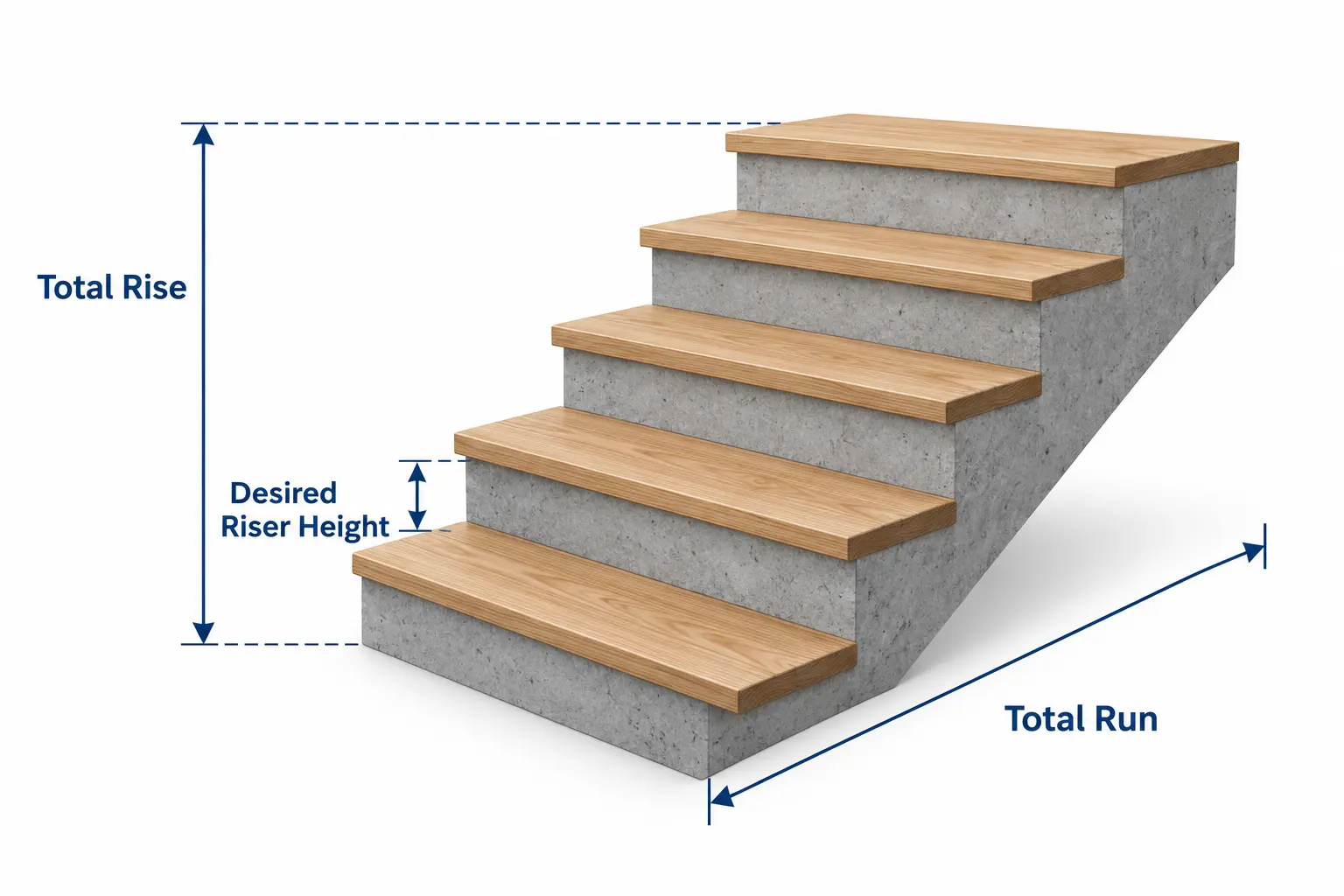
How to Use This Calculator
- 1Enter the total rise of the staircase.
- 2Enter the desired riser height.
- 3Enter the total horizontal run available for the staircase.
- 4Select the appropriate units where unit selectors are provided.
- 5Click Calculate.
- 6Review the calculated riser count, riser height, tread count, tread depth, and stair angle.
Common Uses
- Residential stair layout
- Deck stairs
- Stair rise and run calculations
- Riser and tread calculations
- Stair dimension planning
- Preliminary stair geometry
- Concrete stair dimension planning
Understanding Stair Rise and Run
Rise and run are two of the main dimensions used to describe a staircase. Rise describes the vertical dimension of the stair, while run describes its horizontal extent.
This calculator uses the total rise, desired riser height, and total run to determine the corresponding stair dimensions.
The calculator then uses the calculated riser and tread dimensions to determine the stair angle.
Stair Angle = arctan(Riser Height ÷ Tread Depth)
Stair Risers and Treads
A riser is the vertical portion between adjacent treads. A tread is the horizontal walking surface of a stair.
The calculator determines the number of risers from the total rise and desired riser height. It then calculates the actual riser height by dividing the total rise evenly among the calculated risers.
The tread count is calculated from the riser count, with the calculator using one fewer tread than risers.
The total horizontal run is then divided by the tread count to determine the tread depth.
Riser Height = Total Rise ÷ Number of Risers
Total Rise and Stair Height
Total rise is the vertical distance between the two levels connected by the staircase.
For this calculator, total rise is an input used to determine the number of risers and the resulting riser height.
Accurate measurement is important because changing the total rise changes the calculated stair dimensions.
Measure between the relevant finished levels consistently rather than estimating the vertical distance.
Number of Risers = Ceiling(Total Rise ÷ Desired Riser Height)
Stair Run
Total run describes the horizontal distance available for the staircase.
This calculator uses the total run together with the calculated tread count to determine the tread depth.
Increasing the total run while keeping the tread count unchanged produces a deeper tread. Increasing the tread count while keeping the total run unchanged produces a shallower tread.
Tread Depth = Total Run ÷ Number of Treads
Stair Calculator for Rise and Run
The relationship between rise and run is central to stair geometry.
This calculator starts with the total rise, desired riser height, and total run. It calculates the number of risers and actual riser height, determines the number of treads and tread depth, and then uses the resulting individual rise and tread dimensions to calculate the stair angle.
Because the calculator uses individual riser height and tread depth for the angle calculation, the angle should not be described as simply using total rise divided by total run.
Stair Angle = arctan(Riser Height ÷ Tread Depth)
Stair Angle
Stair angle describes the angle of the stair flight relative to the horizontal.
This calculator calculates the angle from the resulting riser height and tread depth using a right-triangle relationship.
The displayed angle is a mathematical result based on the dimensions entered. It is not a determination of building-code compliance or stair safety.
Angle = arctan(Riser Height ÷ Tread Depth)
How Many Risers Do I Need?
The number of risers depends on the total rise and the desired riser height.
The calculator divides the total rise by the desired riser height and rounds the result up to the next whole riser. It then recalculates the actual riser height by dividing the total rise by that whole-number riser count.
For example, if a staircase has a total rise of 100 inches and the desired riser height is 7 inches, 100 ÷ 7 is approximately 14.29. The calculator therefore uses 15 risers, giving an actual riser height of approximately 6.67 inches.
Number of Risers = Ceiling(Total Rise ÷ Desired Riser Height)
How Many Treads Do I Need?
The calculator determines the tread count from the calculated number of risers.
For the stair calculation used here, the number of treads is one fewer than the number of risers, subject to the calculator's minimum tread handling.
Once the tread count is known, the total horizontal run is divided by that count to calculate the tread depth.
Number of Treads = Number of Risers − 1
Deck Stair Calculator
Deck stairs are a common application of stair-dimension calculations.
For a deck staircase, the total rise represents the vertical distance between the relevant upper and lower levels, while the total run represents the horizontal space used by the staircase.
This calculator can be used to work through the mathematical stair dimensions supported by its inputs.
It does not calculate deck framing, footing requirements, structural capacity, or deck construction details.
Stair Calculator With a Landing
Some stair projects include a landing or a change in direction. A complete stair-and-landing layout can involve additional dimensions beyond the basic stair geometry calculated here.
This calculator does not provide dedicated landing inputs or calculate a landing layout.
A landing therefore needs to be considered separately when planning a staircase that includes one.
Stair Dimensions and Measurement Accuracy
Accurate measurements matter because the calculated stair dimensions depend directly on the values entered.
Measure the actual total vertical rise between the relevant finished levels and use consistent reference points.
Measure the available horizontal run that the staircase will occupy.
Small differences in total rise can change the calculated riser count and actual riser height, while changes in total run affect tread depth.
The calculator provides mathematical results from the entered values. It does not replace on-site measurement or professional design review.
Stair Rise and Tread Relationship
Riser height and tread depth are related parts of the same stair layout.
The calculator first determines a whole-number riser count from the total rise and desired riser height. The actual riser height is then recalculated from the total rise and resulting riser count.
The resulting tread count is based on the riser count, and the total run is divided by that tread count to determine tread depth.
These calculated values describe the mathematical geometry of the staircase based on the inputs provided.
Riser Height × Number of Risers = Total Rise
Concrete Stair Calculations
Concrete stairs use the same basic stair-dimension concepts of rise, run, risers, and treads.
This stair calculator can be used to calculate the supported stair dimensions for a concrete staircase when the project's geometry matches the calculator inputs.
It does not calculate concrete volume, reinforcing steel, footing dimensions, structural requirements, or concrete quantities.
For concrete volume calculations, use the Concrete Calculator.
Checking a Stair Calculation Manually
You can check the main relationships used by the calculator by working through the results from the entered dimensions.
First verify the total rise and desired riser height. Divide the total rise by the desired riser height and round up to obtain the riser count.
Divide the total rise by the riser count to verify the calculated riser height.
Next calculate the tread count from the riser count, then divide the total run by the tread count to verify the tread depth.
Finally, use the resulting riser height and tread depth to check the calculated stair angle.
Angle = arctan(Riser Height ÷ Tread Depth)
Common Stair Calculation Mistakes
- Measuring total rise inaccurately: The total rise directly affects the calculated riser count and actual riser height. Measure between the relevant finished levels carefully.
- Confusing total run with tread depth: Total run is the horizontal distance entered for the staircase, while tread depth is the calculated horizontal depth of each tread.
- Mixing inches and feet: Use compatible units and select the appropriate units where the calculator provides unit selectors.
- Using an estimated total rise: Small changes in total rise can affect the calculated number of risers and resulting riser height.
- Assuming treads and risers are always equal in count: The calculator uses one fewer tread than risers for its stair calculation.
- Rounding intermediate values too early: Keep sufficient precision when checking the calculation and round the final displayed results rather than changing intermediate values manually.
- Treating a mathematical result as code approval: The calculator provides dimensional calculations and does not establish building-code compliance.
Stair Calculations vs. Building-Code Requirements
A stair calculator performs mathematical calculations based on the dimensions provided.
Building codes can impose requirements concerning stair geometry, handrails, guards, landings, headroom, width, and other aspects of stair construction.
Those requirements vary by jurisdiction and project circumstances.
The calculated values from this tool should therefore not be presented as proof of code compliance.
For construction decisions involving safety or structural requirements, verify the applicable local requirements and obtain professional advice where appropriate.
Stair Calculation Quick Reference
| Calculation | Formula |
|---|---|
| Number of risers | Ceiling(Total Rise ÷ Desired Riser Height) |
| Riser height | Total Rise ÷ Number of Risers |
| Number of treads | Number of Risers − 1 |
| Tread depth | Total Run ÷ Number of Treads |
| Stair angle | arctan(Riser Height ÷ Tread Depth) |
Internal Calculator Resources
Use the Square Footage Calculator when you need to calculate the area of a rectangular space.
For concrete volume calculations, use the Concrete Calculator.
For general volume calculations expressed in cubic feet, use the Cubic Feet Calculator.
For project volumes expressed in cubic yards, use the Cubic Yard Calculator.